


How to plan your cycling season: from your first rides to your main goals
You’ll learn how to set realistic cycling goals, divide the year into clear blocks, and create a simple training plan that can be adapted to the weather and your responsibilities. We’ll also cover how to write your rides into a calendar, why it’s important not to underestimate bike servicing right now in winter, and how to track your progress so your motivation doesn’t fade after the first few kilometers.
Step 1: Define what type of cyclist you are
Who are you in the saddle?
Before you start planning specific rides, it’s a good idea to clarify what type of cyclist you actually are. Some people ride mainly for enjoyment and relaxation, others use the bike as a practical means of transport, and some want to improve systematically. All of these approaches are perfectly fine, but each requires a slightly different approach to planning.
Recreational riders usually head out on weekends, ride shorter routes, and mainly look for comfort and enjoyment. Family cyclists plan trips based on the possibilities of their children or partner and don’t focus on kilometers or pace. Commuters ride often but over shorter distances and appreciate regularity. Sport-oriented riders, on the other hand, focus on performance, fitness, and specific goals.
Once you identify the profile that fits you best, planning the entire season becomes much easier.
Step 2: Set realistic goals – from the first rides to the “big dream”
What goals to set so they motivate you, not exhaust you
Well-set cycling goals should motivate you, not stress you out. It works best to combine short-term goals that help you build regularity with medium-term challenges and one main goal for the season. In the first weeks, it may simply be about getting out on the bike once or twice a week. Over time, longer routes, specific trips, or sporting events can be added.
It’s important that goals are specific and realistic. Instead of a vague “I’ll ride more,” a plan like “at least 45 minutes twice a week” works much better. A recreational cyclist may aim for a certain number of kilometers per season, a family rider for regular shared trips, a commuter for several months of consistent commuting, and a sport-oriented rider for a race or improved performance.
Step 3: Divide the year into simple blocks
The season in clear phases: spring – summer – autumn
Planning the whole year becomes clearer when you divide it into several blocks. Spring is ideal for kicking off the season, returning to regular movement, and shorter rides. Summer offers space for longer trips, cycling holidays, and discovering new routes. Autumn then serves mainly to maintain fitness with shorter rides depending on the weather and available time.
This structure helps you avoid overdoing it at the start of the season and accept the fact that cycling has a different character at different times of the year.
Step 4: Put the plan into your calendar
From your head to the calendar: specific days and times
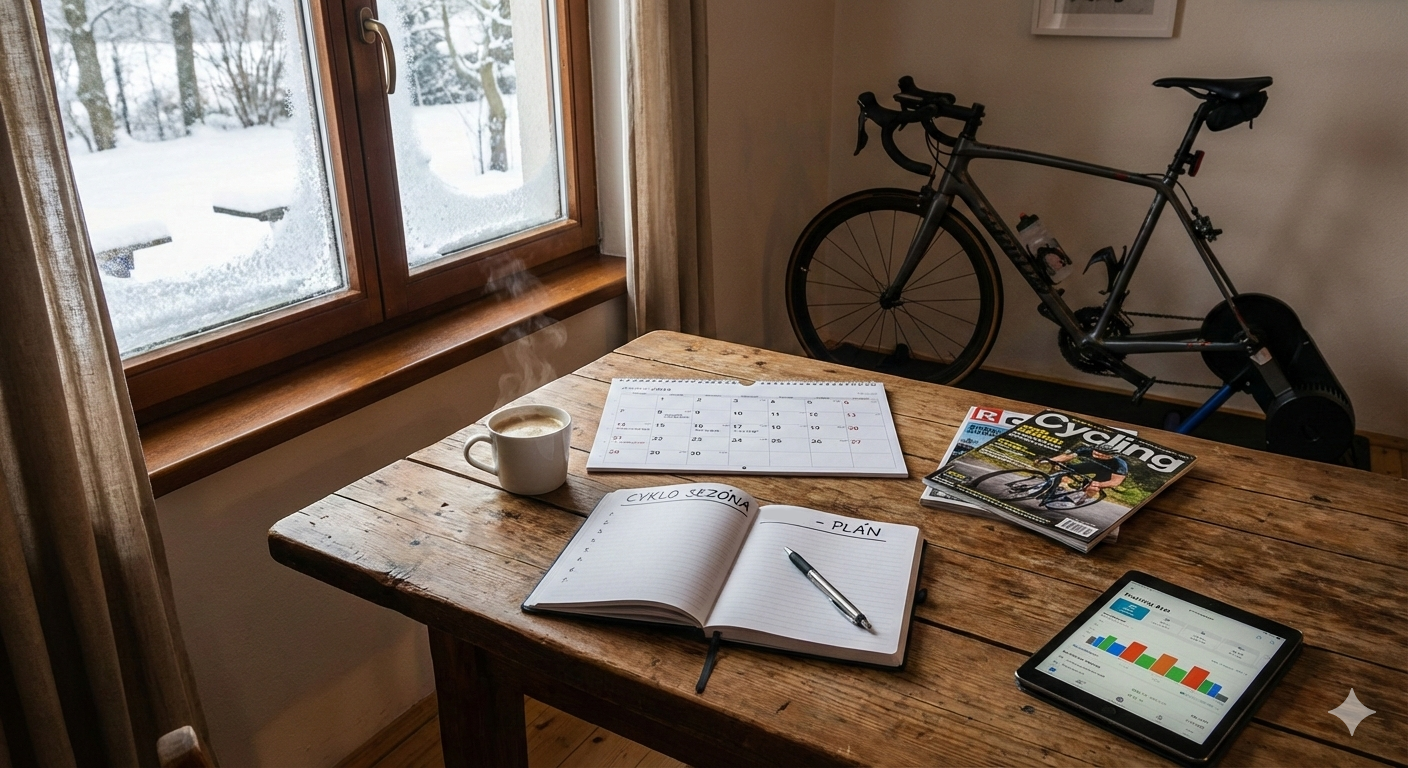
Once you have your goals and a vision of the season, a key step follows—writing your rides into the calendar. Until they have a specific day and time, they remain just wishes. It works well to choose fixed cycling days, for example one evening during the week and a weekend morning, and treat them as a normal part of your schedule.
It also helps to plan with the seasons in mind. In summer, riding in the morning or evening is more pleasant; in spring and autumn, make use of the brighter part of the day. The more specific the plan, the greater the chance it will actually happen.
Example of a simple training plan for cyclists (start of the season)
Weekly schedule (model example)
Tuesday – Ride 1 – easy (approx. 45–60 minutes)
A relaxed pace where you can speak in full sentences. Ideal on flat or gently rolling terrain. The goal is to get the body moving and get used to the bike.
Thursday – Ride 2 – moderate (approx. 60–75 minutes)
A slightly brisker pace, possibly with gentle climbs. It still shouldn’t feel like “chasing performance.” Focus on smooth riding and rhythm.
Saturday/Sunday – Ride 3 – optional (weekend, 75–120 minutes)
A relaxed longer trip, ideally in nature or with family. Pace is secondary; what matters is time spent in the saddle and enjoyment of the ride.
Every 2–3 weeks, plan a slight extension of one ride (by 10–15 minutes).
A shorter but regular training plan is better than an ambitious plan that falls apart after two weeks. The goal of the season isn’t perfect performance, but enjoyment of movement and gradual improvement.
Step 5: Don’t forget the bike – workshops are quiet right now
A bike ready in the garage is the best motivation for the first warmer days.
Without a functional bike, even the best plan falls apart. Right now, while it’s freezing outside, is the ideal time for thorough servicing. You’ll avoid spring queues at workshops and the stress of “the weather is nice, but I have nothing to ride.” Checking the chain, brakes, and shifting will save you money and nerves during the season.
For home maintenance, reliable tools and accessories from brands like Super B, Force, Max1, SKS, or Topeak are useful. If you don’t feel confident servicing the bike yourself, use the winter months to visit a workshop—right now they have more time for your bike than in spring.
Winter is also ideal for a well-thought-out upgrade or buying a new bike. Whether you’re considering brands like Leader Fox, Pells, Ghost, Levit, Stevens, and CTM, or looking for proven classics from Superior, Author, and Rock Machine, choosing calmly at home allows you to better compare specifications and prices.
Step 6: How to track progress so it stays fun
An app, a bike computer, or pen and paper?
Tracking progress helps maintain motivation. Some riders are fine with notes in a diary; others like to see data in an app or on the display of a bike computer. Clear and simple solutions are offered by devices from brands like iGPSport and Sigma, which show essential data without unnecessary complexity. Manufacturers of bike computers often provide their own apps as well. Seeing graphs and completed kilometers in your calendar is a great remedy for winter fatigue.
When the weather isn’t favorable, the option to train indoors also helps. Indoor trainers from brands like Tacx and Elite help maintain fitness and meet your set goals.
Step 7: What if it doesn’t go according to plan?
Adjust the plan as you go
Not every season unfolds exactly as imagined. Work, family, health, or weather can easily disrupt plans. It’s important to treat the plan as a living document that can be adjusted. It’s better to scale back a goal or reshuffle weeks than to stop riding altogether. Even a shorter ride still makes sense.
Start simple and build gradually
Planning a cycling season doesn’t mean tying yourself down with rules. It’s enough to clarify what type of rider you are, set a few realistic goals, divide the year into clear blocks, and write rides into your calendar. The rest will naturally evolve based on your mood, time, and opportunities.
More articles


How to choose a lightweight children”s bike: every gram counts
As cyclists, we know that every extra kilogram on the frame is felt on every climb. But now imagine that you weigh 20 kg and your bike weighs 12 kg. It”s like an adult riding a 50-kilogram monster without a motor. Yet this is the reality for many children on Czech bike paths.
If you want your child to love cycling and not see it as a punishment, a lightweight children”s bike is the most important investment you can make. Let”s take a look at how to choose a children”s bike that will be a joy to ride.


