


How do you choose a kids” bike helmet that your child won”t want to take off?
As cyclists, we know that children’s safety on bikes is an absolute priority. But explaining the biomechanics of an impact to a five-year-old rider is a Herculean task. For young cyclists, a helmet isn’t a safety feature—it’s an accessory that either gets in the way or looks cool. If you want your child to wear head protection willingly, you need to look at the selection through their eyes, but with your technical standards. The key to success is a lightweight children’s helmet with a design they’ll be proud of.
Choosing the right model isn’t just about looks—when deciding how to pick a children’s bike helmet, focus on the combination of safety, weight, and comfort. These factors are what determine whether a child will accept the helmet or reject it.
Why is the weight of a kids’ helmet the most important factor?
While adults focus on grams for aerodynamics, for children it’s all about physiology. A child’s cervical spine is still developing, and the neck muscles are far from fully strengthened. Putting a heavy, cheap helmet from a supermarket on a child’s head means exposing their neck to unnecessary strain and rotational stress while moving.
When looking for the answer to how to choose a kids’ helmet, focus primarily on construction technologies. The top solution is In-mould technology, where the outer shell is firmly bonded with EPS impact foam. The result is extremely low weight that a child stops noticing after just a few minutes. From experience, we know that the tipping point where a helmet starts to feel uncomfortable is around 250 grams.
- Lightweight Cratoni helmets (e.g. the Maxster model) can go well below 230 grams. For a child’s neck, this is a huge relief and often determines whether a ride is enjoyable or uncomfortable.


MIPS: Technology that protects a child’s brain from rotational forces
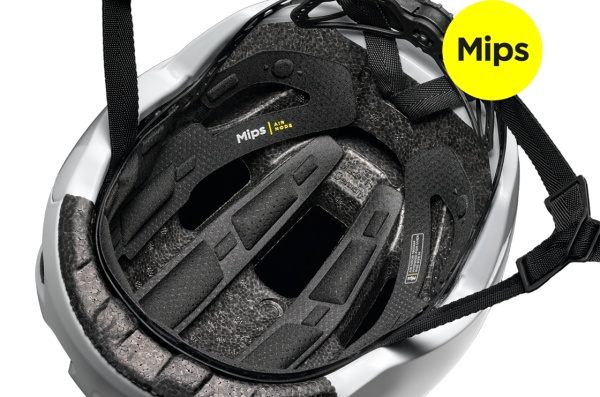
If you want maximum safety for your child, look for models from brands like Uvex or Cratoni with the yellow MIPS (Multi-directional Impact Protection System) label. This technology addresses the fact that bicycle crashes are rarely direct – most impacts occur at an angle, generating dangerous rotational forces affecting the brain.
The MIPS slip-plane inside the helmet allows the shell to move slightly independently from the head, absorbing these forces and significantly reducing the risk of serious injury. It’s a small additional cost, but from a modern scientific perspective, it represents the highest level of protection currently available in a kids’ bike helmet.
Standard helmet vs. full-face helmet: Is a “basic shell” enough or do you need chin protection?
A common question parents ask: Is a standard helmet enough, or do we need a full-face helmet with chin protection? The answer depends on where and how your child rides. If you mostly ride on bike paths and regular roads, a classic lightweight helmet (often called a “bucket” or shell) is ideal thanks to its ventilation and low weight.
However, if your young rider is starting jumps, loves off-road riding, or visits bike parks, a kids’ full-face helmet makes a lot of sense. It protects the face in case of falls onto the handlebars or contact with terrain. Modern full-face helmets for kids are designed to remain surprisingly lightweight while offering full protection of the head and jaw.


Stylish helmets for kids: When design improves safety
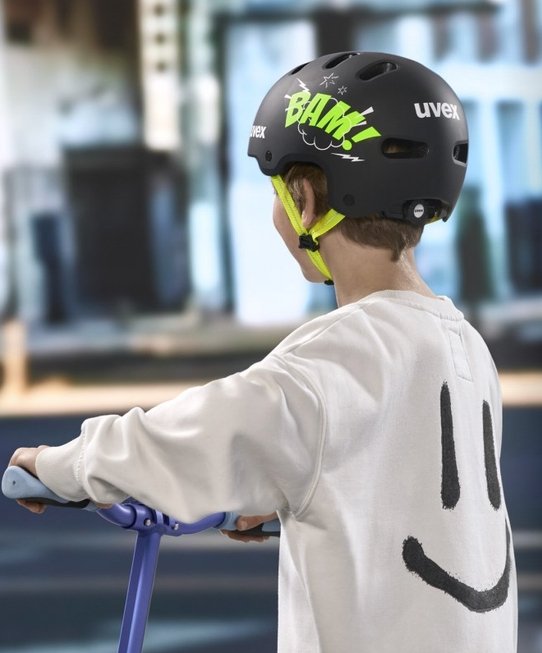
At this age, psychology plays a big role. If a child chooses their own color and design, they’ll feel proud of their gear. A modern kids’ cycling helmet combines both style and functionality.
Bright and neon colors also serve an important safety purpose – on bike paths or in forest shade, a child becomes visible from a much greater distance. Stylish helmets for kids are therefore not just about looks, but also about passive safety in traffic.
Which brands perform best in tests? Uvex and Cratoni under the spotlight
In the cycling industry, it’s not about impressions. When choosing, we recommend following independent tests such as the German ADAC or Austrian ÖAMTC, where factors like stability and temple protection are strictly measured.
- Uvex: This brand consistently scores highly thanks to its Monomatic fastening system. It’s a smart chin mechanism that parents love because it can be operated with one hand and, thanks to padding, never pinches the skin. Skin pinching is one of the most common reasons children develop a dislike for helmets.
- Cratoni: Specialists in ventilation and lightweight kids’ helmets. In tests focused on thermal regulation, they excel thanks to large vents that keep the head cool even during hot summer days.
If you are looking for a more affordable option, Author kids’ cycling helmets are also worth considering. They offer a very good price-to-performance ratio, a reasonable weight suitable for a child’s neck, and a proven In-mould construction that meets the EN 1078 standard. Thanks to easy adjustment and a comfortable fit, they are an ideal choice for recreational riding or as a first bike helmet for kids. In this category, Author is a brand that makes sense for parents who want quality without an unnecessarily high investment.
Small details that make a big difference on rides
When choosing a helmet, pay attention to details that are easy to overlook in a catalog but invaluable in practice. One of them is an insect mesh in the front vents. Most models from Uvex and Cratoni include it as standard. Trust us – a wasp inside a helmet can ruin cycling for a child for an entire season.
Another important factor is helmet lifespan. Parents often ask how long a helmet lasts. Thanks to systems like Uvex IAS, which allow smooth adjustment of both circumference and height, the helmet essentially grows with the child and typically covers two to three years of growth. However, remember one rule: if the helmet has experienced a hard impact on asphalt, its mission is over. Even if the shell looks intact, the internal structure may have micro-cracks that will no longer provide proper protection in another crash.


How to measure your child’s head and ensure a proper fit
Even the best kids’ bike helmet won’t work if it’s the wrong size. Before buying, always measure head circumference with a tape measure – measure horizontally above the ears and about 2 cm above the eyebrows.
Approximate sizes:
- XS: approx. 44–49 cm
- S: approx. 48–52 cm
Correct sizing is essential – always choose based on actual head circumference, not the child’s age.
Expert tip: A properly fitted helmet should not slide toward the back of the head (leaving the forehead exposed) or fall into the eyes. Exactly two fingers should fit between the eyebrows and the helmet edge. The same space should remain between the strap and the chin.
Investing in quality brands like Uvex or Cratoni pays off in comfortable, stress-free rides. Because the best helmet is the one your child doesn’t even notice wearing.
Safety standard: What should you look for?
Every quality kids’ cycling helmet should comply with the European safety standard EN 1078. This ensures the helmet has passed impact, strength, and retention system tests.
If a helmet does not meet this standard, we do not recommend using it – your child’s safety should always come first.
Frequently asked questions when choosing a kids’ helmet
Ideally after any significant impact or approximately every 2–3 years of use.
It’s not mandatory, but it significantly improves protection against angled impacts and is among the best technologies currently available.
The helmet must fit snugly, should not move, and must match the exact head circumference of the child.
Quick overview: How to recognize the right helmet?
| Parameter | Ideal condition (what to look for) | Why does it matter? |
|---|---|---|
| Weight | Under 250 grams | Reduces strain on the child’s neck and fatigue. |
| Technology | In-mould / MIPS | Maximum protection while maintaining low weight. |
| Ventilation | Min. 8–10 vents | Prevents overheating in summer. |
| Fastening | Padded / Magnetic | Eliminates the risk of skin pinching under the chin. |
| Extra features | Insect mesh / Rear light | Improves comfort and visibility on the road. |
| Design | Let the child choose | Ensures they will wear the helmet willingly. |
Tip for you
Did you know that we also offer stylish kids’ cycling gloves to go with helmets?


Before you head out on a bike ride with your child for the first time, read How to teach a child to ride safely (not only) on bike paths


