


- Discount 15%
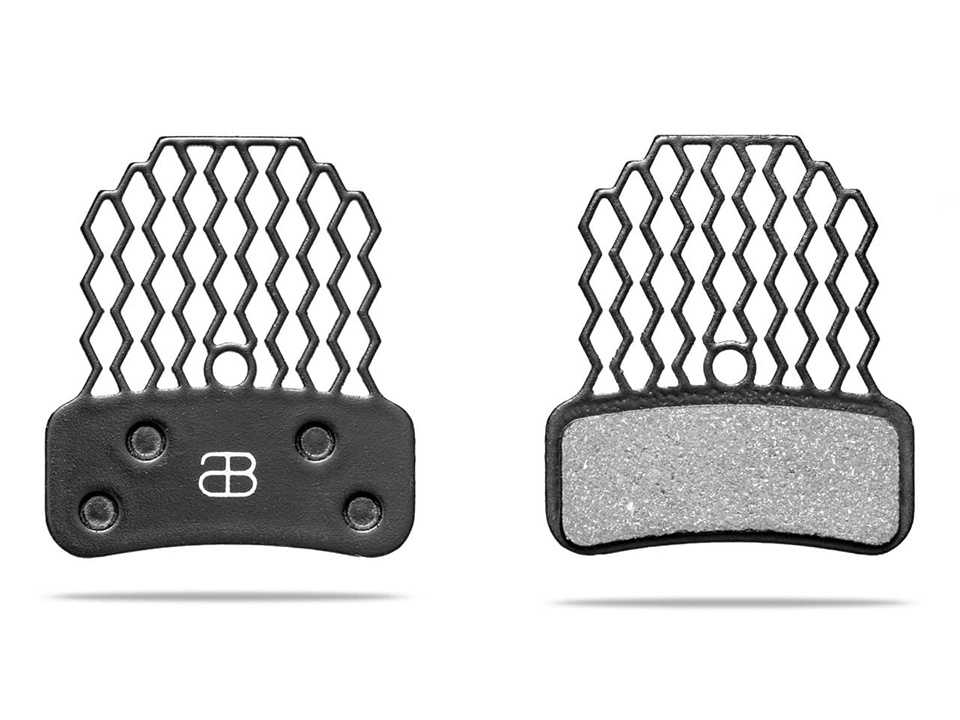
absoluteBLACK disc brake pads GRAPHENpads® SH XTR
 add to cart
 Compare
 Guard
 Ask
Product code: D222498
absoluteBLACK disc brake pads GRAPHENpads® SH XTR
Brake pads suitable for Shimano XTR and other brakes.
GRAPHENpads® – a new era of braking confidence and consistency is here. GRAPHENpads® ceramic pads set a whole new benchmark for the brake pad industry thanks to our unique approach to backplate cooling fin design, a custom graphene backplate coating and a completely new friction compound that uses specially treated graphene instead of toxic copper. These pads are suitable for SRAM road calipers such as eTap AXS, as well as Level Ultimate and others.
Compatible: Shimano XTR BR-M9120, XT BR-M8120,BR-M8020, SLX BR-M7120, DEORE BR-M6120,BR-MT420, SAINT BR-M820,BR-M810, ZEE BR-M640, BR-MT520, Slate T4, Tektro HD-M750, HD-M745, HD-M735, HD-E725
Composition: Ceramic organic Performance friction compound containing graphene. Thermal coating containing graphene. We use no copper or any heavy metals.
Use: All weather conditions
Packaging: Two pads (set for one wheel), one spring
Brake pads are the most important part of the bike when it comes to how confidently you can descend. The key to their optimal performance is keeping pad and rotor temperatures as low as possible (ideally below 400 °C), especially on longer descents. The hotter the pads get, the faster they fade, meaning they lose the ability to slow you down reliably when needed. Overheated pads lose braking consistency and behave differently every time you pull the lever, which greatly reduces your braking confidence and effectively forces you to ride much slower. That is why Shimano introduced cooling fins on disc pads in an effort to reduce their operating temperature. The ideal brake pad delivers the same predictable braking power, initial bite and perfect modulation throughout a long descent. After three years of development, we are convinced that this is exactly what we have achieved with our GRAPHENpads® brake pads. Machine testing and thermal imaging show that we have reduced pad and rotor temperatures by up to 35% compared to the competition and completely eliminated brake fade. Rotors are repeatedly heated to temperatures above 500 °C, which increases the risk of the rotor material softening through tempering. Tempering softening causes increased rotor wear and warping and leads to reduced braking performance. That is why it is extremely important to dissipate heat from the rotor-pad interface as quickly as possible.
* The first pads on the market to contain specially treated graphene in their friction compound, which significantly improves braking performance, durability and heat transfer to the backplate.
* Because the backplates are fully coated with a heat-dissipating graphene layer, much greater heat transfer from the friction material to the cooling fins was achieved, while heat radiation (IR spectrum) increased by more than 20% (which is very significant).
* The first pads on the market with patented angled cooling fins for better airflow and cooling.
Angled cutting brings three main benefits. 1. A 40% larger total heatsink surface compared to standard cutting methods. 2. Significantly more airflow than traditional heatsinks, increasing convective heat dissipation. 3. Most importantly, thanks to the 45-degree angled cut, all surfaces radiate heat away from the brake pad. Thermal radiation (infrared spectrum) is highest perpendicular to the surface, so in a standard heatsink each fin radiates its heat onto the neighbouring fin, keeping more heat in the part. Our pads radiate all heat away from the backplate.
* To date, GRAPHENpads® are the only brake pads on the market that completely eliminate toxic copper, ahead of new regulations (copper brake dust has been proven toxic to aquatic organisms, which is why a new California regulation will ban the use of copper from 2025).
* Exceptional brake pad and rotor life. According to our own tests, one set of pads lasts on average up to 8000 km in hilly terrain. The graphene in the pad friction material also extends rotor life by embedding graphene particles in the micropores of the rotor braking surface.
* The pads are made in the EU.
* Predictability and power that give you full control over your braking.
* Better modulation and quicker stopping
* More confidence on descents
* No brake fade, more consistency and a reliable braking feel corner after corner, even on the toughest descents.
* Very quiet, even on long descents.
* Reduce hand fatigue thanks to much less lever force needed for powerful braking compared to the competition.
The GRAPHENpad friction compound was developed with the help of a renowned European disc pad specialist with decades of experience and unique equipment that allows precise performance testing.
Graphene is still a very new material, especially in friction brake compounds. Thanks to its truly unique properties and years of testing, we have developed a friction material like no other. In the automotive industry, where almost every major car maker has already filed several patent applications for graphene-containing friction compounds, it is clear that this is the future of brake pads. New regulations coming into force from 2025 will ban the use of copper powder in pads. Graphene is not only an excellent replacement for copper, but also a significant performance upgrade. We are the first company in the cycling industry to offer graphene in a friction compound.
To understand why graphene is such a good material for friction compounds, we need to understand how a friction compound is made. A typical organic friction compound contains five classes of ingredients: fibrous material made from inorganic/organic/metallic fibres (e.g. copper), a binder (e.g. thermoset polymer), "filler" (various soft ceramic powders), one or more lubricants/friction modifiers (e.g. graphite, copper), and one or more abrasives (hard ceramic powders). The binder, usually a phenolic resin that holds all the ingredients together, has a very high coefficient of friction, so friction modifiers/lubricants must be added to lower it and allow braking modulation. Copper is a great example of a material that not only works as a fibre but is also a lubricant and conducts heat to the backplate. Graphene, on the other hand, is several times stronger than copper, conducts heat 3-6 times better and its coefficient of friction is several orders of magnitude lower. By eliminating copper and finding the right ratio of graphene and other ingredients, we have created a unique friction material that delivers exceptional performance.
Installation: Follow the correct installation procedure. Skipping this procedure will lead to a below-par experience.
1. Remove the wheel and the old brake pads.
2. Clean the inside of the caliper and the rotor surface with brake cleaner (or use isopropyl alcohol)
3. Clean the brake disc and rotor surface. Gently push each piston back into the caliper body (e.g. with a large screwdriver). Then fit the new pads and spring
4. The most important part – riding at about 20 km/h (12 mph) in a safe environment, brake evenly until you slow down to walking pace. Repeat 20 times. Then make 10 hard stops
| model year: | nespecifikován |


