


How to measure bike tyre pressure: TyreWiz, Airspy, Airmax and gauges
No more thumb tests
Tyre pressure is the cheapest upgrade you can make to your bike, yet it is also the one most often overlooked. Most of us still check it by squeezing the tyre between our fingers or by glancing at the needle on the pump. In the meantime, smart sensors have arrived that monitor pressure continuously and send it to your phone or bike computer, much like the TPMS in a car.
In this article, we explain why it is worth measuring tyre pressure accurately, how the sensors work and how the three best-known models differ: SRAM TyreWiz 2.0, SKS Airspy and Schwalbe Airmax. We also look at digital bike tyre pressure gauges, which offer a simpler and cheaper way to get your pressure right.
Why the right bike tyre pressure matters
The tyre is the only part of your bike that touches the ground, and the pressure inside it affects almost everything you feel when riding. A tyre that is too hard bounces over bumps, grips less in corners and passes every impact straight through to your body. A tyre that is too soft squirms in corners, and hitting an edge can cause a pinch flat or damage the rim. Schwalbe points out that underinflation significantly increases rolling resistance and leads to premature tyre wear, and recommends checking pressure with a gauge at least once a month.
Modern bikes are more sensitive to pressure than they used to be. Wider tyres and tubeless systems let you ride at low pressures – often around 2 bar on a mountain bike, and even lower with tubeless. In this range, every tenth of a bar counts. On e-bikes, correctly inflated tyres also help extend battery range.
The problem is that the usual ways of measuring are imprecise. A thumb test cannot tell 1.6 bar from 2 bar. An analogue pump gauge with a scale up to 10 or 12 bar is too coarse for low pressures, and according to SRAM a standard pump is only accurate to around ±5%. On top of that, air gradually escapes from a tyre even without a puncture, so the pressure you set last week may no longer be right today.
How a tyre pressure sensor works
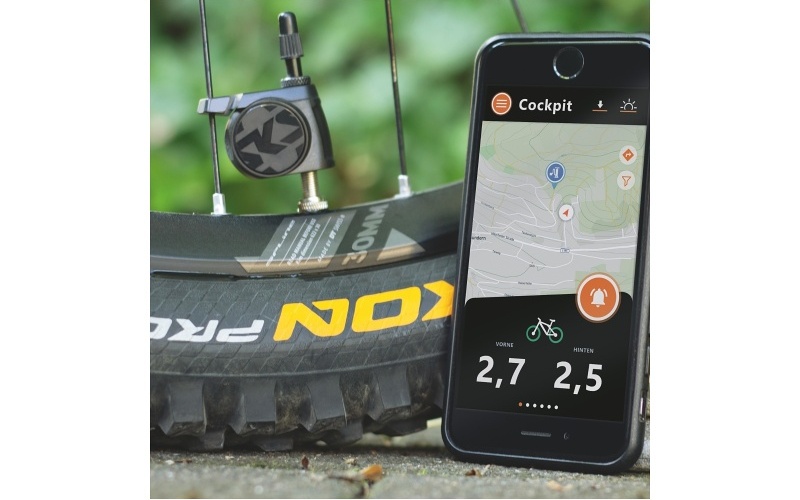
A sensor is a small unit weighing 10 to 20 grams that screws onto the valve in place of the valve cap. Inside, it houses a pressure sensor, often a thermometer, a wireless chip and a coin cell battery. It measures pressure continuously, including while you ride, and sends the data via Bluetooth to your phone or via ANT+ to your bike computer.
The app displays the current pressure and temperature and alerts you to underinflation or a slow leak before you set off. Most apps can also calculate a recommended pressure based on the type of bike, tyre width and rider weight. The most valuable thing, though, is that the sensor tells you the pressure you actually rode at, not just the pressure you started with. Pressure changes during a ride with temperature, altitude and load.
Three sensors in detail
SRAM Quarq TyreWiz 2.0
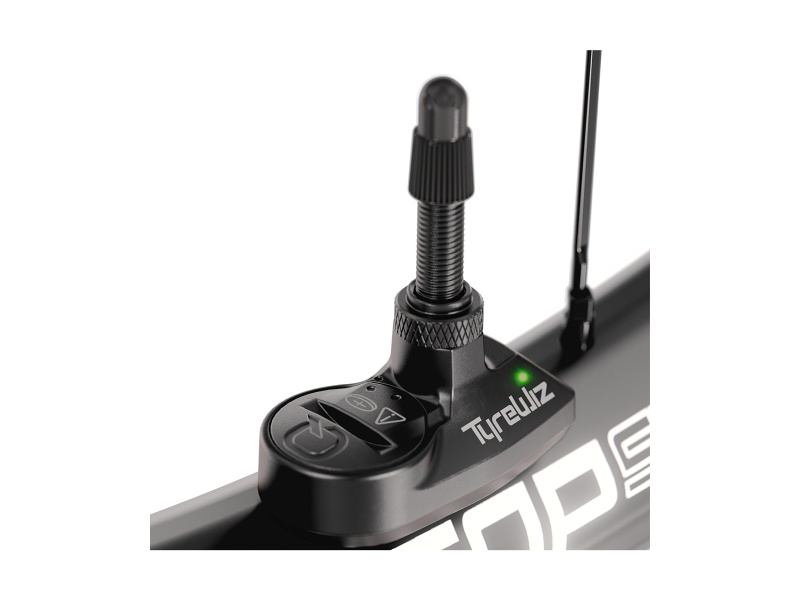
TyreWiz from Quarq (part of SRAM) is one of the pioneers of the whole category. According to SRAM, the second generation has been redesigned for greater accuracy and better compatibility with different rim depths. It measures with ±2% accuracy at a resolution of 0.1 psi, and thanks to a universal rim adaptor it sits flat on both road and MTB rims. The sensor is designed for Presta valves and mounts on valve stems of various lengths, which are not included in the box.
The sensor connects to the SRAM AXS app, which gives personalised pressure recommendations. For riders who already use SRAM AXS wireless components, it is the natural choice, as everything is in one app. Most bike computers can also display the data via ANT+ and Bluetooth. A handy feature is the LED, which alerts you when the pressure is outside the target range, whether too low or too high, so you don”t even need your phone for a pre-ride check. The sensor weighs 10 grams, is IPX7-rated and its CR1632 battery lasts up to 300 hours.
SKS Airspy
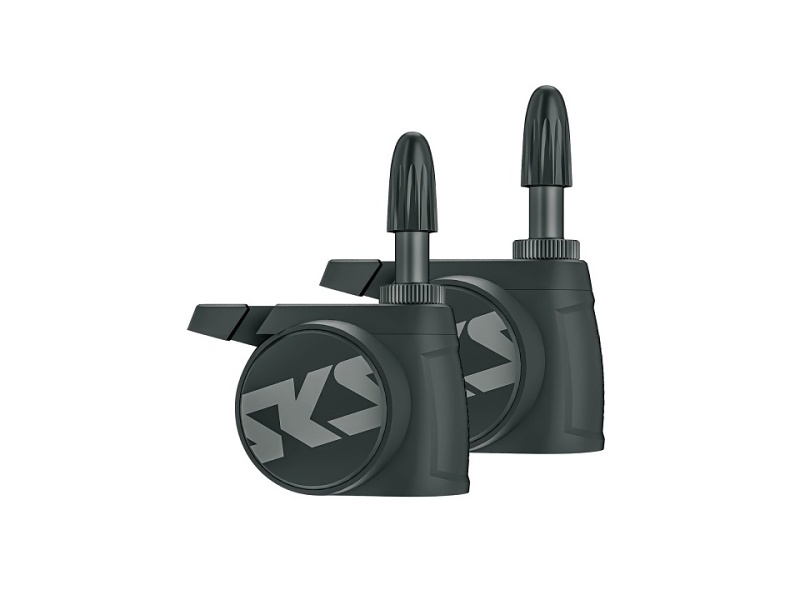
The German “air spy”, SKS Airspy, is sold as a set of two sensors for the front and rear wheels. Fitting is simple: screw the adapter onto the valve, push the sensor on and you are ready to ride. Airspy then measures pressure continuously, and the app sounds an alarm if it deviates.
The data is shown in the SKS MYBIKE app, and thanks to Bluetooth and ANT+ it can also be read by a Garmin bike computer with the appropriate app. The sensor weighs 18 grams, measures up to 8.3 bar, is dustproof and watertight, and runs on a standard CR2032 battery. It is also suitable for tubeless tyres. A nice bonus is that you can use it as a portable digital pressure gauge every time you pump up your tyres.
Schwalbe Airmax Smart Bike Sensor
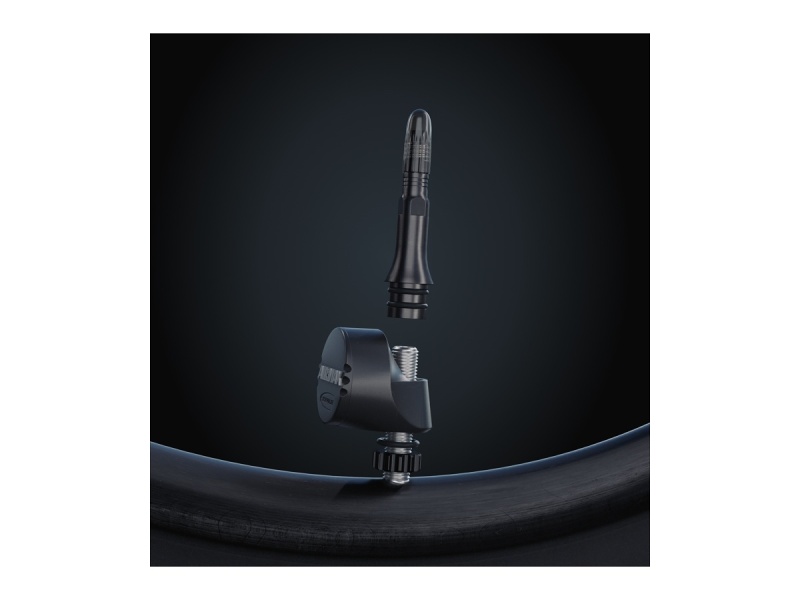
The lightest of the three, Schwalbe Airmax, weighs 12 grams, measures up to 10 bar, and the manufacturer quotes 400 hours of ride time. In addition to pressure, it also measures temperature, is IP67-rated, and the LED on the sensor lights up green when the pressure is set correctly. It works with both inner tubes and tubeless setups.
Its strong point is the software. The Schwalbe app includes the Pressure Prof tool, which calculates the ideal pressure based on tyre size, riding style and terrain, and also helps calibrate the sensors. If pressure drops, the app alerts you with a notification and a sound. The sensor communicates via Bluetooth and ANT+ and fits Presta tubeless valves, inner tubes with threaded Presta valves and the Schwalbe Clik Valve. It is sold as a set of two.
Comparison at a glance
All three sensors are sold in pairs and transmit data via Bluetooth and ANT+. Airmax is the lightest and has the highest range, TyreWiz offers the best declared accuracy and the closest integration with SRAM AXS, and Airspy is the easiest to fit thanks to its valve adapter.
| SRAM TyreWiz 2.0 | SKS Airspy SV | Schwalbe Airmax | |
|---|---|---|---|
| Sensor weight | 10 g | 18 g | 12 g |
| Max. pressure | – | 8.3 bar | 10 bar |
| Declared accuracy | ±2% | – | – |
| Valve | Presta | Presta | Presta, Clik Valve |
| Data transmission | Bluetooth, ANT+ | Bluetooth, ANT+ | Bluetooth, ANT+ |
| App | SRAM AXS | SKS MYBIKE | Schwalbe |
| LED on sensor | yes | – | yes |
| Protection | IPX7 | dustproof, watertight | IP67 |
| Battery / life | CR1632 / up to 300 h | CR2032 / – | – / 400 h |
| Pack contents | 2 pcs | 2 pcs (front + rear) | 2 pcs |
A dash means the manufacturer does not specify the value.
A cheaper option: a digital bike tyre pressure gauge
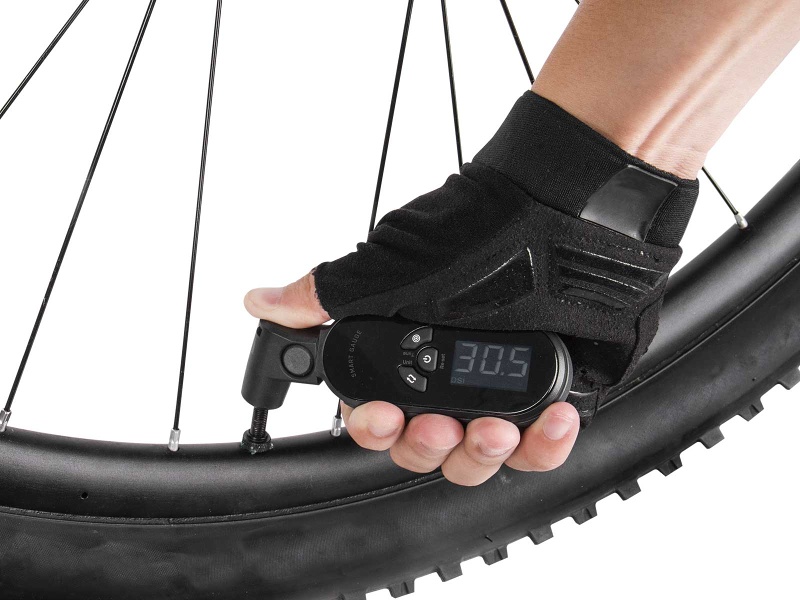
A smart sensor is not the only way to get accurate pressure. If you don”t need to monitor pressure while riding, a digital gauge that you use to check it before setting off is all you need. Unlike a pump needle, it shows pressure to a hundredth of a bar, so at low mountain bike pressures you can finally tell the difference between 1.6 and 2 bar.
The most versatile option is the Topeak SmartGauge D2X. It measures up to 18 bar with a resolution of 0.1 psi, its SmartHead fits both Presta and Schrader valves without any adjustment, and it can also check the pressure in a fork or shock. An air release button lets you fine-tune pressure precisely. The SKS Airchecker works in a similar way for Presta and Schrader valves up to 10 bar and measures pressure in real time as you release air. A simple choice is the Schwalbe Airmax Pro, with a range of up to 11 bar for Schrader and Presta valves. And if you want a digital gauge always to hand in your saddle bag, the compact Beto pressure gauge will do the job.
A gauge lacks only what makes sensors interesting: ride data and slow-leak alerts. For setting the right pressure before a ride, however, it is all you need. You will find more gauges in the pump accessories category, a floor pump with a gauge is ideal for inflating at home, and for air forks and shocks there are shock pumps.
Pump and gauge in one: an electric mini compressor
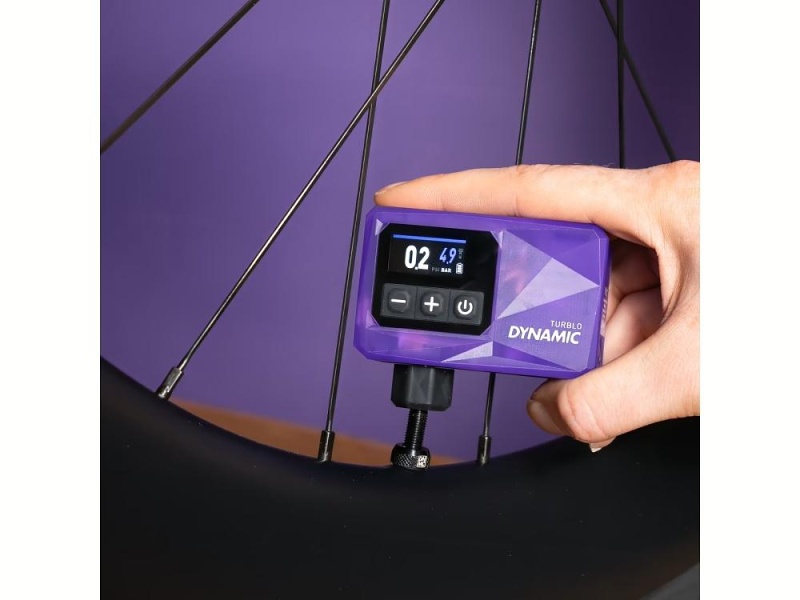
An interesting combination of pump and gauge are Dynamic”s electric mini compressors. They have a digital pressure sensor and an auto-stop function: you set the pressure you want and the compressor stops by itself once it gets there. The Dynamic Turblo 2 fits in a jersey pocket, weighs 119 grams and reaches a maximum of 8 bar. On a single charge, it can inflate up to five road tyres to 5 bar or eight MTB tyres to 1.5 bar. The original Turblo, weighing 115 grams, is similar. The more powerful Turblo+ reaches up to 10 bar, stores four preset pressures – for example for the front and rear wheel – and doubles as a power bank.
Sensor or gauge?
A sensor makes the most sense where riders run low pressures and the details matter: on mountain bikes, gravel bikes and tubeless tyres. Road cyclists and triathletes will appreciate it too, as rolling resistance and early detection of slow leaks matter to them. On e-bikes and bikepacking trips, it helps you keep an eye on pressure under heavier loads and on long routes.
If you ride recreationally and prefer to set your pressure before a ride, a digital gauge is all you need. Whatever you choose, check your tyre pressure at least once a month. Checking pressure is also one of the steps you can do yourself as part of a spring bike service.
What to keep in mind when fitting a sensor:
- Check the valve type and length. The sensor must sit flat against the rim. You will find the right valves in the Valve Caps category.
- With tubeless tyres, keep the valve free of sealant, otherwise it can distort the readings.
- Pair the sensor with the app at home and set your target pressure and alert threshold.
- Mark which sensor goes on the front wheel and which on the rear.
Find your ideal pressure step by step. Start with the value from the app”s calculator or the tyre manufacturer”s chart, then adjust in tenths of a bar, ideally always on the same stretch of road or trail. Always stay within the minimum and maximum pressure printed on the tyre sidewall.
Where the technology is heading
Valve-mounted sensors are currently the most accessible and versatile solution, but development continues. America”s Outrider hides a sensor weighing less than 4 grams inside a tubeless tyre, Austria”s Tubolito has built one directly into a lightweight TPU inner tube, and Zipp integrates it into the rim of its 303 SW and 353 NSW wheels. Schrader, a well-known valve manufacturer, is bringing its experience from automotive TPMS to bikes and e-bikes.
At the very top end, systems no longer just measure pressure – they change it. Gravaa KAPS and Scope Atmoz have a pump or an air reservoir in the hub, and the rider adjusts pressure on the fly using a handlebar remote. For now, these are expensive solutions aimed mainly at professional racers. They show, however, that tyre pressure is becoming a metric riders track as closely as heart rate or power.
Frequently asked questions
Does a sensor work with inner tubes?
Schwalbe Airmax does, provided the tube has a threaded Presta valve. SKS Airspy is fitted to the valve via an adapter and is also suitable for tubeless tyres. TyreWiz 2.0 mounts on separately sold valve stems, so check compatibility with your bike in advance.
Can a sensor handle rain and bike washing?
Yes, the sensors are waterproof – TyreWiz, for example, is IPX7-rated. Just don”t point a pressure washer directly at them.
How long does the battery last?
It depends on the model and how much you ride. SRAM quotes up to 300 hours for TyreWiz, and Schwalbe quotes 400 hours of ride time for Airmax. TyreWiz and Airspy use standard coin cell batteries (CR1632 and CR2032).
Does a sensor affect wheel balance?
At 10 to 18 grams, the effect is negligible.
Can I swap sensors between bikes?
Yes, just unscrew them and assign them to another bike in the app. Both bikes must have compatible valves, though.
Related articles
- Spring bike service: 7 steps you can do yourself
- 10 bike gadgets that also serve as gift ideas for cyclists
Sources
- SRAM Quarq TyreWiz 2.0 (SRAM)
- SKS Airspy Set (SKS)
- Schwalbe Airmax Smart Bike Sensor (Schwalbe)
- Schwalbe Airmax, specifications (Schwalbe)
- Schwalbe Airmax Pro (Schwalbe)
- Topeak SmartGauge D2X (Topeak)
- SKS Airchecker 2.0 (SKS)
- Dynamic Turblo 2 (Dynamic)
- Outrider TL Mini (Bikerumor)
- Tubolito Tubo-Road SYNCD (Tubolito)
- Zipp 303 SW with AXS Wheel Sensor (SRAM)
- Schrader AIRsistant (ebike-mtb.com)
- Gravaa KAPS (road.cc)
- Scope Atmoz (Scope)
More articles


Mahle vs. Bosch: Which motor is better for a gravel e-bike?
Gravel e-bikes have become a symbol of freedom, performance, and technological minimalism. They combine the lightness of a road bike with the adventurous spirit of off-road riding and add electric assistance that expands your possibilities. The basis of every e-gravel bike is its drive system – and it is this that determines how the bike will perform, how it will behave on hills, and how naturally it will ride above the assistance limit. Today, we will compare in detail the two most commonly used systems in modern gravel e-bikes: Mahle X20 / X35 and Bosch Performance Line SX.


