


Winterising your e-bike: how to store the battery over winter and what’s new thi
Last year, we tried to convince you that an e-bike does not necessarily have to spend the winter in the garage. Many of you took our advice and now ride all year round. However, if you put your bike away for the winter, you should know that an incorrectly stored battery can lose more capacity over a few winter months than during an entire riding season. In this article, we follow up on How to Ride an E-bike in Winter: we will show you how to winterise your e-bike properly and take a look at new products that make winter riding considerably easier this year.
Keep riding or store your e-bike for winter?
There is no single correct answer to this question. An e-bike can handle winter conditions as long as you take proper care of it. What matters most is how you use your bike and where you can store it.
| You should probably keep riding if… | You should probably store it for winter if… |
|---|---|
|
|
|
|
|
|
|
|
If you plan to keep riding, you can find the basics in last year”s article and in our guide Which Tyres to Use in Winter. Further down in this article, you will find this year”s latest additions. If you are putting your bike away for winter, continue straight to the next section.
Our tip:
Putting your bike away does not have to mean four months without exercise. You can maintain your fitness throughout the winter on a trainer. We explain how to choose one in the article Exercise Bike or Indoor Bike Trainer?, and you can browse our range in the Trainers and Rollers category.
What happens to the battery while the bike is stored?
A lithium-ion battery ages even when you are not riding the bike. This is technically known as calendar ageing, and its rate is mainly influenced by two factors: state of charge and temperature.
- A fully charged battery keeps its cells at their highest voltage. If it remains like this for several months, it loses capacity faster than a battery stored at roughly half charge.
- An almost empty battery poses an even greater risk. Every battery slowly self-discharges, while the battery management system (BMS) also consumes a small amount of energy. A battery stored in November at 5% charge can fall below its safe minimum during the winter. The protection system may then shut it down, and it may no longer be possible to recharge it.
- Heat accelerates chemical ageing, while freezing temperatures are harmful during charging. The ideal solution is therefore somewhere in between: a dry room at approximately 10–20 °C.
Drive system manufacturers such as Bosch and Shimano therefore recommend storing the battery at approximately 30–60% charge. On the display, this usually corresponds to two or three bars out of five.
Never charge the battery when it is freezing cold. Charging lithium cells below 0 °C is one of the worst things you can do to a battery. Instead of being stored in the anode, lithium can deposit on its surface as a metallic layer, a process known as lithium plating. This causes irreversible capacity loss and, in more serious cases, can lead to an internal short circuit. If you bring the battery in from the cold, for example from an unheated garage or after a ride, never charge it immediately. Allow it to acclimatise to room temperature for at least 1–2 hours first.
How to winterise an e-bike step by step
The entire process takes about an hour and can save you the cost of a new battery, which can easily cost several hundred euros.
- Wash the bike thoroughly. Road salt and mud left over from autumn rides can attack the chain, cassette and bolted joints throughout the winter. Use a gentle bike cleaner and lukewarm water. Avoid pressure washers, as they can force water into bearings and towards the motor.
- Clean and lubricate the chain. Degrease it and apply a good-quality chain lubricant. For winter storage, a wet-condition lubricant is preferable because it offers better protection against corrosion.
- Charge the battery to 30–60% and remove it from the bike. Wipe both the battery contacts and the contacts on the bike dry.
- Store the battery in a dry place at 10–20 °C, away from radiators, direct sunlight and flammable materials. A dry cellar or storage room is preferable to an unheated garage.
- Check the charge level once every 6–8 weeks. If it falls below 30%, recharge it to roughly half capacity. Always charge at room temperature, never below 0 °C.
- Inflate the tyres to the maximum recommended pressure. A properly inflated tyre is less likely to deform when the bike remains in one position for a long time.
- Store the bike on a stand. Be careful with ordinary wall hooks: many are rated for around 15 kg, while an e-bike can weigh 20–28 kg even without its battery. A safer solution is a sturdy e-bike stand or floor stand from the Racks and Stands category.
- Schedule a winter service. Did you know that bike workshops are usually much less busy in November and December than they are in March? During a service, the motor, brakes and bearings can be checked, and the drive system software can also be updated. We explain what a comprehensive service includes in the article How to Know When Your Bike Needs a Major Service.
Our tip:
If your bike spends the winter in a shared cellar or garage, make sure it is properly secured as well. You can find inspiration in our article The Most Common Ways to Protect Your Bike.


What”s new for this winter season?
Last year, we wrote that winter riding usually means a 20–30% reduction in range as well as much shorter days. Over the past year, several products have appeared that directly address these issues.
1. Bosch PowerMore 250 Wh range extender: get your winter range back
The PowerMore 250 is a bottle-sized battery that attaches to the bottle cage mounting points and connects to the bike”s charging socket. It weighs 1.6 kg and works with both PowerTube and CompactTube batteries within the Bosch Smart System.
In figures: with a Performance Line CX motor and a 625 Wh main battery, it adds more than 40% extra range; with a 750 Wh battery, it adds more than 33%. That is more than the amount of range typically lost to cold weather. In practice, this means that a route you can complete on a single charge in summer should still be manageable with a reserve in January. Charging to full capacity with a 4A charger takes approximately 3.2 hours.
PowerMore has another advantage in winter: it is compact. You can easily carry it in a backpack to keep it warm and only fit it to the bike when you need it.
Important: PowerMore only works with the Bosch Smart System (roughly bikes from model year 2022 onwards with a Kiox 300/500, Purion 200 display or LED Remote). It is not compatible with older Bosch systems or drive systems from other brands.
Our tip:
A cheaper way to reduce winter range loss is a neoprene battery cover. For a relatively small investment, it helps the battery stay within its operating temperature range for longer. Read more below in the If You Keep Riding section.
Before buying a new battery, take a look at our e-bike batteries and chargers categories. If your bike uses a different drive system, a replacement battery with a higher capacity may be available. We compared the major drive systems in the article Battle of the Giants for 2026: Bosch vs. Yamaha vs. DJI Avinox.


2. Belt instead of chain: a bike that road salt cannot ruin so easily
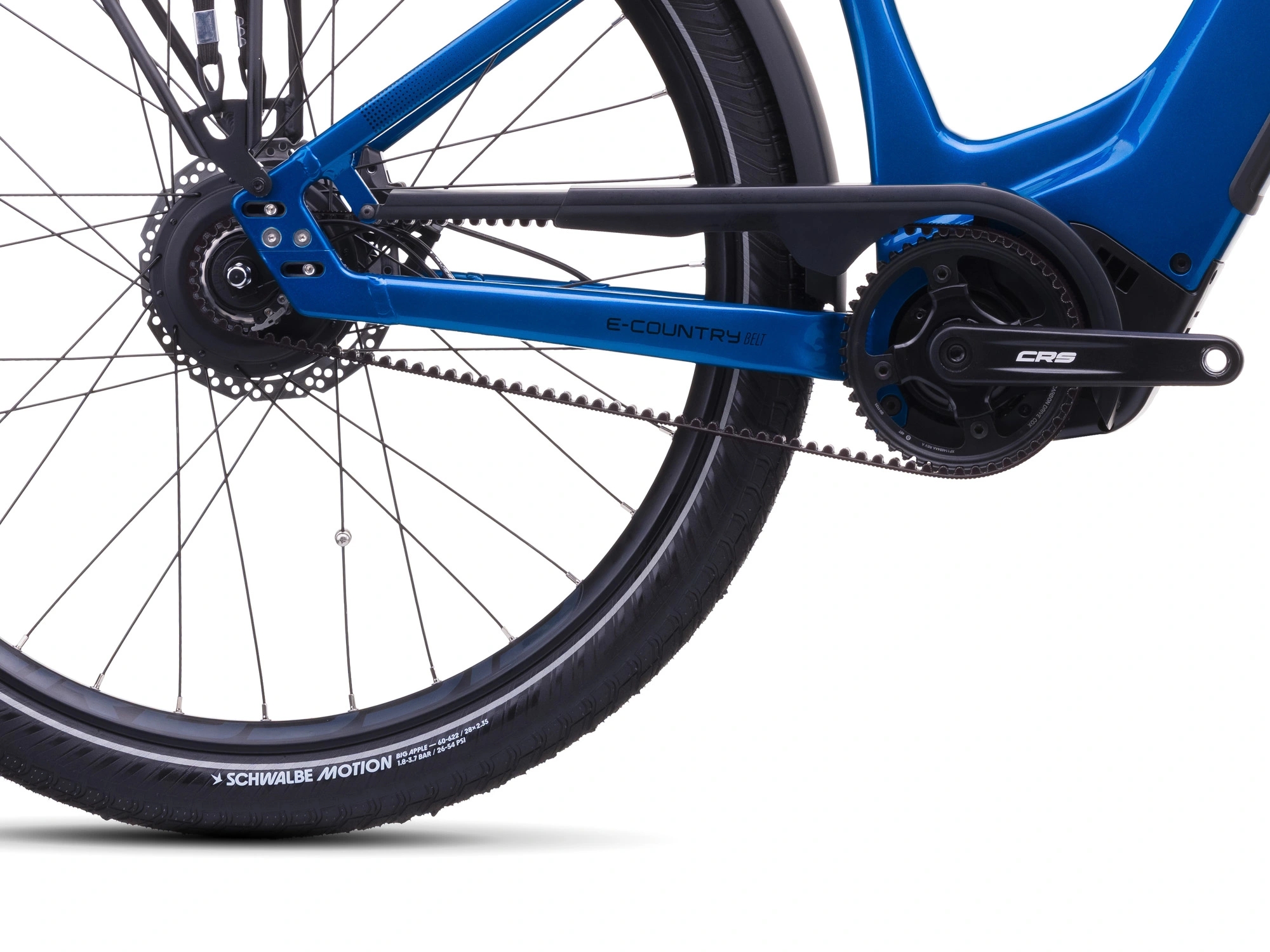
The chain is one of the most vulnerable parts of a bike in winter. Salt, water and grit can wash away its lubricant within a few weeks, causing it to begin rusting. A toothed belt is made from a composite reinforced with carbon fibres: it does not rust, requires no lubrication, runs quietly and can last several times longer than a chain. Because a belt cannot shift between sprockets like a chain, it is combined with an internally geared hub, where the shifting mechanism is protected from dirt and road salt. For year-round commuting, it is one of the lowest-maintenance solutions currently available.
New for the 2027 season is the Crussis e-Country BELT 7.11: a low-step city e-bike with a Panasonic GX Power Plus mid-drive motor (75 Nm), a 715 Wh LG battery with a range of up to 170 km, and a five-speed internally geared hub. Schwalbe Big Apple tyres and a suspension fork with 100 mm of travel can also cope with rough winter roads. You can find more models in the City Electric Bikes category.
3. Radar lights: eyes in the back of your head on short winter days
After the clocks change, darkness arrives at around five o”clock and the ride home from work often takes place after sunset. A rear light with radar monitors traffic up to roughly 140 metres behind you and warns you about approaching vehicles with an audible alert or via your bike computer display. At the same time, the light can increase its intensity or change its flashing pattern as a vehicle approaches, helping drivers notice you sooner. We tested how the individual models perform in practice in our article Bike Lights with Radar. One of the latest additions to the range is the Bryton Gardia R300L.
A powerful front light is also essential alongside a radar. For unlit cycle paths, we recommend at least 800–1,000 lumens. You can browse suitable models in the Front Lights and Rear Lights categories.


4. GPS alarm for Bosch e-bikes
For owners of bikes equipped with the Bosch Smart System, the Bosch GPS eBike Alarm Connect Module is a useful addition. The module is hidden inside the bike, triggers an alarm if the bike is moved and sends a notification to your smartphone. If the bike is taken away, it can show its location. It is especially useful if your bike is stored in a shared cellar or garage during the winter.
Note: GPS tracking and the eBike Alarm feature require a subscription in the Bosch Flow app after the trial period (1 year free) ends.
If you keep riding: winter essentials
We covered winter riding technique, tyre pressure and clothing layers last year. Here is a short checklist of what a winter-ready e-bike should have:
- Full-length mudguards. They are not just about keeping your back clean. They also help keep salty, muddy water away from the motor, bearings and electrical connectors. You can choose from the Mudguards category, including additional guards and covers.
- A neoprene battery cover. A battery brought outside warm from your home will maintain its operating temperature much longer when insulated with neoprene. As a result, the range decreases less in freezing temperatures, while the cover also helps protect the contacts from salty spray. These covers are intended for batteries mounted externally on the frame or rear rack, such as Bosch Active/Performance Line or Shimano STePS E6000 batteries. A fully integrated battery hidden inside the frame is already insulated to some extent by the frame itself.
- Winter tyres with a more aggressive tread pattern, or studded tyres for ice. Read more in our article Which Tyres to Use in Winter.
- Winter brake pads. Organic (resin) pads are quiet and easy to modulate in dry conditions, but in wet weather, mud and road salt they can wear several times faster, while cold temperatures can also reduce their performance. Before winter, check the thickness of the friction material and consider switching to metallic (sintered) pads, which generally last considerably longer in winter conditions. However, make sure your brake rotor is compatible with metallic pads. Rotors marked “resin only” are not. You can find suitable options in the Brake Pads category.
- Warm hands and feet. On an e-bike, you often pedal less intensively and therefore generate less body heat. Fingers and toes are usually the first to get cold. Winter gloves and overshoes can help, as can proper winter cycling shoes.
- Clean the bike after every ride on salted roads. Lukewarm water, a cloth and fresh chain lubricant are usually enough. Our article The Most Common Bike Maintenance Mistakes explains what else to watch out for.


Planning a new e-bike? Autumn is a great time to buy
The 2027 models arrive in autumn, while this year”s and older models start appearing in the sales. They often differ from the latest models only in colour or small specification details, but can cost hundreds or even thousands of euros less. Buying now also means you still have a good choice of sizes, and when spring arrives you can simply get on and ride. By March and April, the most popular sizes are often sold out.
Not sure which drive system to choose? You can find guidance in our articles How an E-bike Works and Battle of the Giants 2026. Browse the full range in the Electric Bikes category. → Electric Bikes Sale


Related articles
More articles

10 bike gadgets that also serve as gift ideas for cyclists
Are you looking for bike accessories that will increase safety, comfort, and enjoyment while cycling? We have prepared an overview of practical bike equipment and gifts for cyclists that will delight every enthusiast. Whether you”re heading out on a weekend trip, cycling to work every day, or planning a longer bike trek, smart bike gadgets will make every ride more enjoyable.


Mahle vs. Bosch: Which motor is better for a gravel e-bike?
Gravel e-bikes have become a symbol of freedom, performance, and technological minimalism. They combine the lightness of a road bike with the adventurous spirit of off-road riding and add electric assistance that expands your possibilities. The basis of every e-gravel bike is its drive system – and it is this that determines how the bike will perform, how it will behave on hills, and how naturally it will ride above the assistance limit. Today, we will compare in detail the two most commonly used systems in modern gravel e-bikes: Mahle X20 / X35 and Bosch Performance Line SX.


